
When I was a missionary for The Church of Jesus Christ of Latter Day Saints in San Carlos, Chile, Region Bio Bio, back in 2009, every Saturday we ate lunch with a tiny, ancient woman named Hermana Celementina. She lived alone in a dilapidated single-level home with one large, dark room that was almost bare of any furniture apart from the table we ate at. There were missing floorboards, and her “kitchen” was a small side table next to a single, wall-mounted porcelain sink that looked like the bathroom sink from my high school locker room.
She fed us the same thing every Saturday–one bowl of beans followed by one bowl of lentils. Both bowls were always amply filled, and at first I struggled to finish it all. But it was the kind of meal that stuck to your ribs, and we always left feeling supremely contented. There was usually nothing else with the meal. It was so basic, but I grew to savor those lunches. I don’t know what she seasoned those porotos y lentejas with, but it was the comfort meal of my week, and she never missed a Saturday.
Before living in Chile I don’t think I had ever eaten a lentil in my life. But ever since my mission I have had a fond nostalgia for the little legumes that have been affectionately termed the “poor man’s meat” (Sally Fallon, Nourishing Traditions, p.495). Lentils are arguably the most nutrient dense of the legumes and require comparatively short soaking time.
Like all grains, seeds, and nuts, the outer layer of the lentil contains phytic acid, which is an enzyme inhibitor, meaning that it can prevent the absorption of vitamins and minerals in the digestive tract. The outer bran, by design, allows the grains, seeds, nuts, legumes, etc. to survive the trip through the digestive system of a bird or animal, for example, and ensures that the seed will be deposited well-fertilized in a new location. In some cases, the seeds of a certain plant will not germinate unless they have been digested first.
As you can imagine, it seems rather unproductive to consume food in a form that blocks its nutrients from being absorbed by the body. Yet this is the way most of us consume grains due to the expediency of our factory farms which harvest, store, and mill grain in its dormant state. This is where the lost method of sprouting comes into play.
“Any seed can be made to germinate [unless it has been irradiated] by increasing its moisture and holding it at the proper temperature. Resting seeds contain starch, which is a storage product and a source of future energy…[for growing] into a plant…Enzymes are present in the resting seed but are prevented from being active by the presence of enzyme inhibitors. Germination neutralizes the inhibitors and releases the enzymes. Enzyme inhibitors are part of the seed machinery and serve a purpose. But these inhibitors are out of place in our bodies” (Sally Fallon, Nourishing Traditions, p.114).
This soup is the best reproduction I have found yet of the flavor of Hermana Clementina’s lentils. I also like to add a little kielbasa and sometimes a sweet potato for accent flavors.
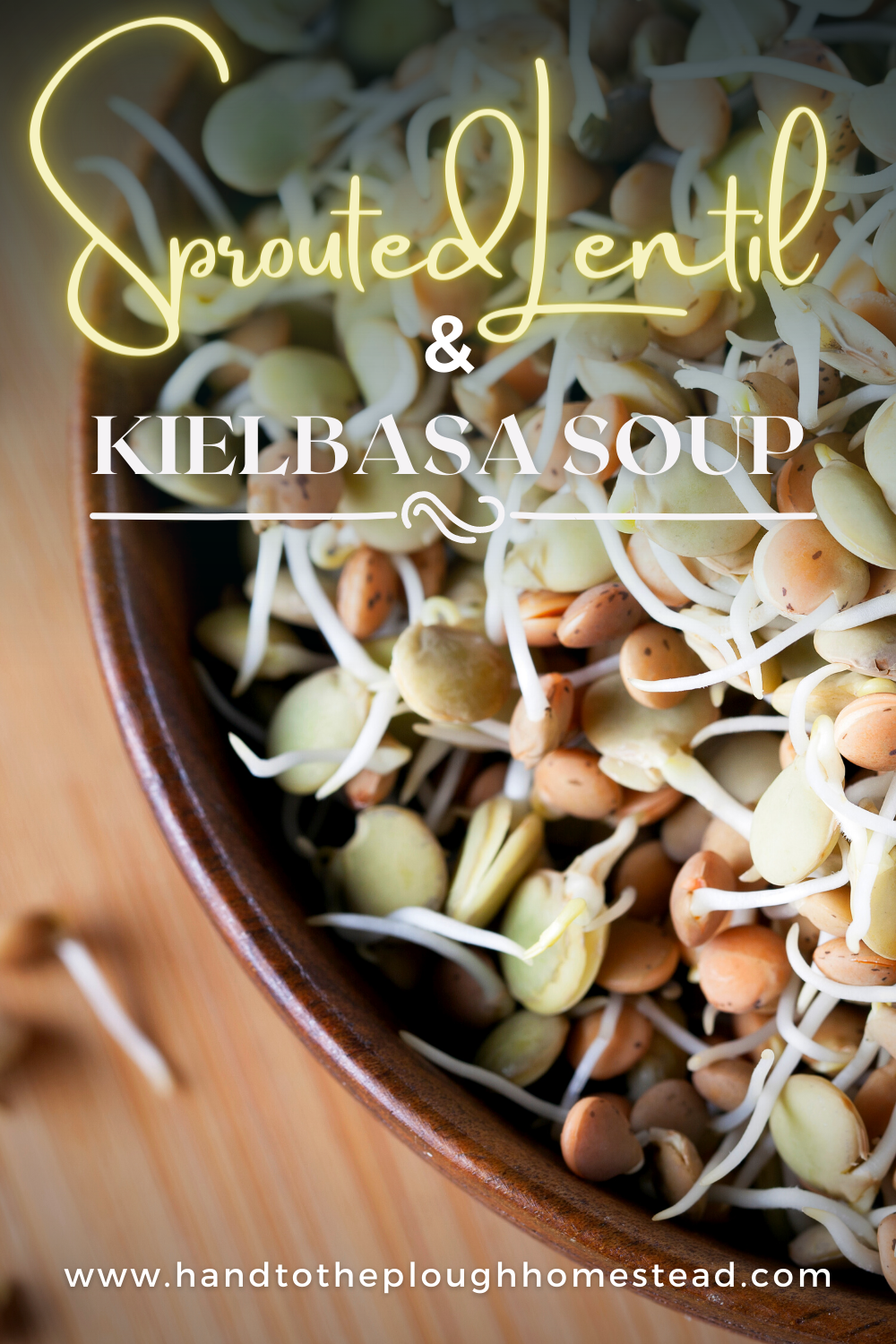
Before I knew about the nutritional and digestive advantages of sprouting, I did it by accident. I soaked the lentils intending to make this recipe with them the following day. When my meal plans fell through, the lentils stayed in the fridge for several days and sprouted. At first, in my naivety, I worried that they could no longer be used. I couldn’t have been more wrong. In their sprouted form, they were, in fact, BETTER for us.
In a culture where the aim to preserve and shelf-stabilize products has saturated our diet with “embalmed” foods, what could be more alive than to consume a food that is actively germinating at the moment it enters your digestive system?
Sprouted Lentil & Kielbasa Soup
The nutrients in this comfort meal are enhanced and more bio-available when prepared using traditional sprouting methods.
- heavy bottomed stock pot
- strainer
- 2 cups Green Lentils
- 6 cups Chicken Bone Broth
- 1 TBSP Olive Oil
- 1/2 cup Chopped Onion
- 2 cloves Garlic
- 1 Polska Kielbasa
- 2 Bay Leaves
- 1 tsp salt
- 1 tsp coarse black pepper
- 2 tsp Turmeric
- 2 tsp Cumin
- Fresh Parsley
-
Cover lentils with water and let soak at room temperature overnight.
-
The following day, strain and rinse lentils and let sit in strainer on the counter or in the fridge for an additional day or until sprouts begin to emerge.
-
When sprouts are at desired length, begin meal preparation.
-
Dice onion and saute until tender in a tablespoon of olive oil. Add garlic, followed by chopped kielbasa. Allow kielbasa to brown slightly.
-
Add bone broth, lentils, and spices, and let simmer about 30 minutes. Lentils will swell and split.
-
Serve topped with fresh parsley.
-
*Optional* Add diced sweet potatoes in the same step as the onion.
 Hand to the Plough Homestead
Leave a comment