

One December years ago I attended a theatre production entitled “Joyful Noise,” which dramatized the story behind George Frederick Handel’s famous oratorio Messiah.
Back in 1741 an opera house was not exactly considered an estimable venue, and no one had ever attempted to portray sacred scripture on a stage before. Most people felt Handel’s attempt was something akin to a drive-through wedding–content too sacred to be couched in a venue so profane.
To add to the controversy, the lead soprano, Susannah Cibber, had been involved in a conspicuous adultery scandal. What could be more blasphemous than holy scripture delivered by an infamous sinner in what would have today been like a grubby movie theater?
The following is an excerpt from the “Joyful Noise” play script:
JENNENS: “Either a thing is sacred or it is not. My scripture collection is sacred. These–opera tunes–are not.”
EGERTON: “Exactly so. Our Lord is not the hero of an evening’s entertainment. You are dragging God into the mud, Mr. Handel, and the town is losing its very sense of the holy!”
HANDEL: “But that is exactly where God should be–in the mud!
JENNENS: “Herr Handel!”
EGERTON: “Revolting!”
HANDEL: “Of course! Listen, Bishop, if you shut God up inside your splendid St. Paul’s cathedral–if you don’t let Him go outside into the mud and muck of the streets–what hope is there for the town? What hope is there for Susannah Cibber? What hope is there for me?
God must go into the world or the world will never be sacred…”

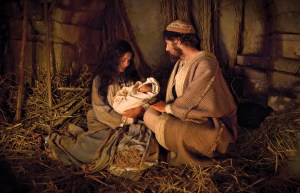
One of Jesus Christ’s many titles is “Emmanuel,” a Hebrew name meaning “God with us.” The particulars of the Nativity story are as familiar to the non-religious as the most orthodox Christian. We know that He came to Earth in the most ordinary way, like the rest of us. But have we fully accepted the idea of a god who was “in all points…like as we are” (Hebrews 4:15)?
Just how serious is He about being with us? And what makes us, like the clergymen in the play, “shut God up,” set limits on Him, and put Him out of our reach? We have thoughts like–“God loves people, but not people like me,” “God forgives sins, but not sins like mine,” and we believe ourselves.
In theory, the idea of God being with us should evoke reassurance, but there is also an element of subconscious uneasiness–the pressure of who God is compared to who we are that demands some kind of action.
For some of us, the impulse is to run away from God and avoid the confrontation entirely. “If I don’t believe in God then I don’t have to feel guilty for the things I’ve done,” we surmise.
For others, the defense is at best to negotiate and at worst to rebel. We change our narrative about God and His expectations and thereby imagine that He approves of us or at least excuses us.
Perhaps magnifying the separation between us and God makes Him seem more powerful to us. Or perhaps keeping God at arm’s length is actually a coping mechanism intended to make us feel more comfortable in our unholiness.
The unavoidable reality is that a God who rubs shoulders with us is a God who changes us. We may fight Him or flee from Him, but remaining as we are is not an option.
When the ancient Israelites under Moses were invited to ascend the mountain into God’s presence, they were afraid and preferred Moses to mediate for them (Exodus 20:18-21). God then decided, “Let them make me a sanctuary, that I may dwell among them” (Exodus 25:8). Subsequently, the Tabernacle was built replete with symbolism of progressing back into the presence of God.
Clearly, it doesn’t contaminate God to keep company with us, but we are restless to relieve the discomfort of our conspicuous misalignment with Him.
Christmas is not just about God coming to Earth. It is about God coming to YOU.
It is about Immanuel wading into the messes of your life and not being repulsed by you or the mess.
Christmas means all that is painful, or painfully ordinary, about your life is common experience that Christ has WITH YOU.
If we let Him come be with us, surely He will drive the unholiness out of us and make even the least of us as He is.
“And He leads His children on, to the place where He is gone” (Once in Royal David’s City).
Merry Christmas from the Homestead.
“I would that ye should understand that God Himself shall come down among the children of men and shall redeem his people,” (Mosiah 15:1).
To watch the entire production of Handel’s Messiah performed by the Tabernacle Choir at Temple Square click here.
For additional reading about the history of Handel and Messiah, click here.
[hubspot type=”form” portal=”23768508″ id=”dcc59ea8-935c-42cd-be2b-7c3b6c9b689f”]


 Hand to the Plough Homestead
Leave a comment